Tire Services in Ottawa
Balancing, puncture repair, rotation, seasonal changeover, TPMS service and storage. Below is what each one actually involves, including the cases where the honest answer is that a tire cannot be saved.
Tire balancing
A wheel and tire assembly is never perfectly evenly weighted. Balancing finds the heavy spot on the machine and offsets it with small counterweights on the rim. Get it wrong and the assembly wobbles as it spins — which you feel as a vibration that appears at a particular speed range and fades above and below it.
The tell is where you feel it. A vibration through the steering wheel usually points at the front wheels; one you feel through the seat and the floor usually points at the rear. Either way it is worth fixing quickly, because an out-of-balance wheel scallops the tread and wears the tire unevenly, and that wear does not come back once it is there.
- Every tire we mount is balanced on the machine as part of the job, not eyeballed.
- Balancing is not alignment. Balancing fixes vibration; alignment fixes pulling and edge wear. They are different problems with different fixes.
- Weights can be thrown off by a pothole impact or lost over time — a vibration that appears suddenly after a hard hit is worth checking.
Tire repair
Not every puncture is repairable, and the honest answer sometimes costs us a sale. A puncture in the crown — the flat tread area across the middle of the tire — is generally repairable. Damage to the sidewall or the shoulder is not, because that part of the tire flexes constantly and has no steel belt behind it. A patch there will fail, usually at speed.
The correct repair is a combined plug and patch fitted from inside the tire, which means the tire comes off the rim so the inside can be inspected for damage the outside does not show. An external plug pushed into the hole without dismounting is a roadside fix to get you home, not a repair.
- Crown punctures within the repairable area: repairable. Sidewall and shoulder damage: not repairable, and we will not pretend otherwise.
- We dismount the tire so the inside can be inspected — running a tire flat can damage the inner liner in ways that are invisible from outside.
- Ontario’s safety inspection standard fails tires with sidewall repairs, so an improper repair can also cost you a certificate.
Tire rotation
Tires do not wear evenly across a vehicle. On a front-wheel-drive car the fronts do the steering, most of the braking and all of the driving, so they wear noticeably faster than the rears. Rotation moves them around on a schedule so the set wears down together instead of leaving you replacing two tires at a time.
There are exceptions worth knowing about. Directional tires — including several of the winter tires we fit — have a rotation direction moulded into the tread and can only move front-to-back on the same side of the car. Staggered fitments, where the rear tires are wider than the fronts, often cannot be rotated at all.
- Every oil change is a sensible rhythm for most drivers.
- Directional tires rotate front-to-rear on the same side only. Tell whoever does the work, or they end up running backwards.
- A year-round all-weather set needs rotation more than a seasonal set does, because it never gets the natural repositioning a changeover provides.
Seasonal changeover
Two ways to do this, and they are not the same job. If your winter tires are on their own rims, the changeover is a wheel swap: wheels off, wheels on, torqued and pressures set. If you have one set of rims, each tire has to be broken off the bead, dismounted, the other one mounted and rebalanced — more labour, more cost each time, and more wear on the tire beads and the TPMS sensors.
If you are keeping the car more than two winters, a second set of rims usually pays for itself in changeover labour alone, and it makes the swap fast enough to book on a lunch break.
- Go by temperature, not snowfall: at or below about 7 °C an all-season compound has already stiffened. In Ottawa that is usually the second half of October.
- Book early. Every shop in the city is full the week after the first real snowfall.
- Wheels go back on with a torque wrench to your vehicle’s specification, not an impact gun — over-torquing warps brake rotors.
TPMS — tire pressure monitoring
Most vehicles on the road now carry pressure sensors inside the wheels, and the warning light on your dash is driven by them. The sensors have consumable parts: the valve stem seals, collars and nuts are a service kit that should be replaced whenever the tire comes off the rim, and the sensor batteries eventually die and are not replaceable on their own.
The seasonal reality in Ottawa is that the light comes on the first genuinely cold morning of the year, for almost everyone. Air contracts as it cools, so pressure drops with temperature — a set that was correct in October reads low in November without anything leaking. That is worth topping up rather than ignoring, because an underinflated tire runs hot, wears its shoulders, and handles worse.
- New service kits go on with every tire change — the seals and collars are consumables, not permanent parts.
- Sensors need to be relearned to the vehicle after a wheel swap on many vehicles; we handle that as part of the job.
- A light that comes on with the first cold snap is usually physics, not a puncture. A light that comes on in mild weather is worth investigating.
Seasonal tire storage
If you have nowhere sensible to keep a second set — no garage, no basement space you want four tires in, street parking — ask us and we will talk about what storage looks like for your situation.
However you store them, the principles are the same: clean and dry, out of direct sunlight, away from anything that generates ozone such as an electric motor, and stacked or shelved rather than hung by the tread. Rubber ages whether it is driven on or not, which is why a well-stored ten-year-old winter tire is still not a winter tire any more.
- Mark each tire with its position before it comes off, so it goes back on in the right rotation slot.
- Store clean and dry, out of sunlight, and away from electric motors.
- Tires age out. Check the DOT date code on the sidewall — a set with plenty of tread can still be too old to trust.
Buying tires, not just servicing them?
We have written a guide to each of the tire lines we fit most often — what each is actually good at, and where it falls down for an Ottawa driver.
Tire service questions
Straight answers, from the counter at Beech Street.
Not automatically, but it is worth checking. New tires on a vehicle that is out of alignment will wear unevenly from day one, which is an expensive way to find out. The signs are the car pulling to one side, an off-centre steering wheel, or feathered wear on the edges of the old tires. Wheel alignment is covered on our suspension and steering page.
If the nail is in the crown — the flat tread area across the middle — usually yes. If it is in the sidewall or the shoulder, no, and no reputable shop will tell you otherwise: that part of the tire flexes constantly and has no steel belt behind it, so a repair there fails. We dismount the tire either way so the inside can be inspected.
Every oil change works well for most drivers. The important thing is consistency rather than a precise interval — the point is to move the tires around before uneven wear becomes permanent. Directional tires can only move front-to-rear on the same side, and some staggered fitments cannot be rotated at all.
Air contracts as it gets colder, so pressure genuinely drops with temperature. A set that was correct on a mild October afternoon can read low enough on a cold November morning to trigger the light without anything leaking. Top them up to the placard pressure. If the light comes on in mild weather, that is a different conversation.
If you are keeping the car more than about two winters, usually yes. The changeover becomes a wheel swap rather than a tire-off-rim job — quicker and cheaper each time, and easier on the tire beads and the TPMS sensors. The saving in labour alone tends to cover the rims within a few seasons.
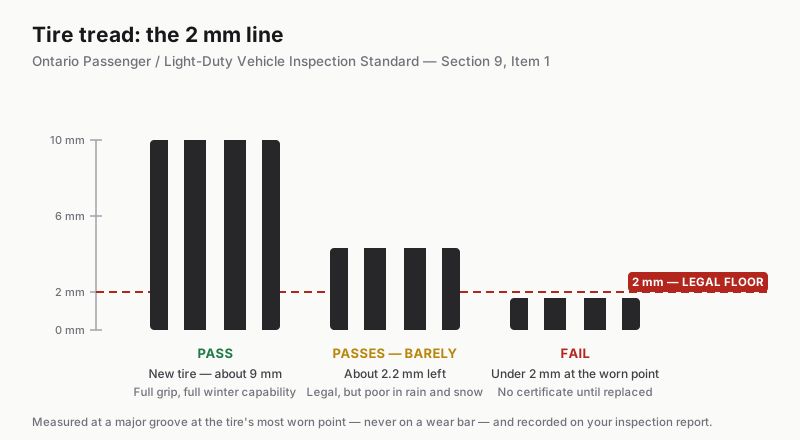
Ontario’s safety inspection fails a passenger tire below 2 mm of tread, but that is a legal floor rather than a recommendation — a winter tire stops behaving like a winter tire well above it. Also check the DOT date code on the sidewall: rubber ages whether you drive on it or not. And look for uneven wear patterns, which usually point at alignment, balance or inflation rather than at the tire.
What Ottawa Customers Say About Our Service
"I dropped my car off at Franco Garage around 11:15am (no appointment, they took me right away) and by 12:30pm they had already ordered my car battery AND installed it! The cost was amazing. They only charged me for the battery itself (under $200) and $15 for labour. Everywhere else I called prior to Franco Garage was quoting between $250-$432 for the battery alone and a high labour cost, not to mention long wait times. I will definitely bring my car back to Franco Garage!! What an incredible experience. The service was extremely fast and the guys working were honest, reliable and really personable!"
Natasha Ferrill
3 months ago
"Noticed I had a deflating tire and a 6AM trip to Montreal the next day. The guys were already fully booked for the day, but still squeezed me in for a quick fix. I didnt even have to wait anywere, they were done in under 15 minites. Both mechanics were very polite and even offered to walk i to the ahop and showed me exactly what was causing the leak in the tire. They knew I was in a rush, but still charged me a fair price. I couldn't be happier, they actually made my day :)"
Yehor Sanko
3 months ago
"Fair and competitive rates. Friendly service and no BS! Thanks from the Dad trying to manage a brake job on his son’s car from Toronto!"
jdyyz
6 months ago
Book your tire service
Balancing, a puncture, a seasonal swap or a TPMS light — book online or call us. Family-run on Beech Street since 1981.