Most drivers know a safety inspection checks tread depth. Fewer know that Ontario's standard also fails vehicles for mismatched tire sizes, sidewall repairs, retreaded tires, and mixing radial with non-radial tires — even when every tire has plenty of tread.
Here is the complete picture.
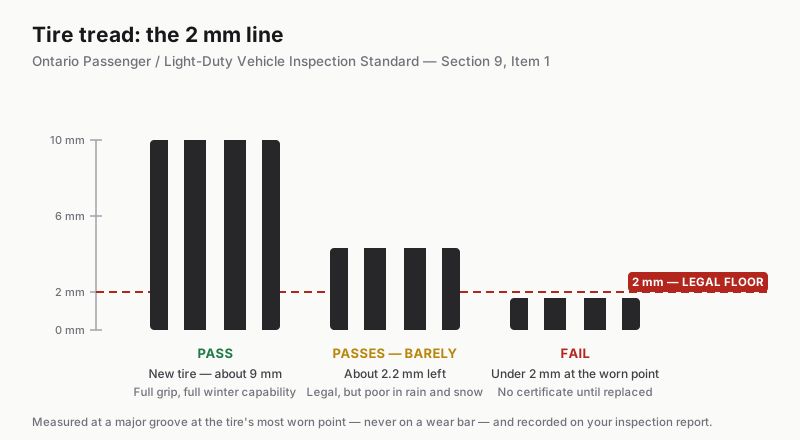
The tread depth limit: 2 mm
A tire fails when tread depth is less than 2 mm at the point of minimum tread depth.
Three details matter in that sentence:
"Point of minimum tread depth." Not an average. The technician locates the shallowest spot on the tire and measures there. A tire with 5 mm across most of its face and 1.8 mm on the inner shoulder fails — and uneven wear like that usually means an alignment or suspension problem worth investigating anyway.
"At a major groove." The measurement is taken in one of the deepest moulded grooves, using a proper tread depth gauge. It is explicitly not taken on a wear bar.
It gets recorded. Tread depth is one of the items the standard requires on your inspection report. If a tire is replaced after a failure, both the original and replacement depths are recorded.
2 mm is legal, not safe
Worth saying plainly: 2 mm is a legal floor, not a recommendation. Wet braking distance and hydroplaning resistance degrade sharply below about 3 mm, and winter traction is largely gone before that. A tire that passes at 2.1 mm will pass — and will also be genuinely poor in a November rainstorm on the Queensway.
If you are replacing tires anyway, replacing them before they reach the limit is the better call.
Tires have to match — on the same axle
The standard fails a vehicle when:
- The nominal tire size is different between the left and right tires at the front, or between the left and right at the rear
- A radial tire is mixed with a non-radial tire anywhere on the vehicle
- The wheel or rim size does not match the tire size according to the tire manufacturer's specifications
- A tire has a lower load rating or capacity than specified by the vehicle manufacturer
- A tire is labelled "Not for Highway Use" or otherwise marked as not intended for on-road use
- A tire is sufficiently oversized or undersized to contact a vehicle component in a way that affects safe operation
Note the front and rear are assessed separately, so different sizes front to rear — normal on many performance and rear-drive vehicles — is fine. It is a left-to-right mismatch on the same end that fails.
If you have been replacing tires one at a time as they wear out, this is worth checking against the sidewall markings before you book.
Sidewall damage
The standard fails a tire when:
- Ply separation is evident or body cords are exposed
- There is a bulge in the sidewall more than 10 mm high
- The casing is broken or distorted
- There is a plug-type repair, or a rubber-coated or cured-rubber plug used in the sidewall
- UV degradation damage is more than 3 mm deep
Sidewalls flex constantly and carry the tire's structural load, which is why they are not repairable. A bulge means the internal belt or ply has already failed and the tire is being held together by rubber — that one deserves immediate replacement regardless of any inspection.
Tread damage
Separate from depth, the tread itself fails for:
- A cut or crack greater than 25 mm long that extends deeper than a major tread groove
- A cut or crack that extends into body cord, or any exposed body cord
- Any missing piece of original tread more than 25 mm across its longest dimension
Retreads and re-grooving
A retreaded, re-capped or rebuilt tire installed in any location fails a passenger or light-duty vehicle. There is no exception for the spare position or a trailer axle on the vehicle itself.
Re-grooved tires also fail.
Wheels, rims and spacers
- Wheels and rims fail if damaged, broken, bent, cracked or distorted, or welded or repaired in a way that does not meet industry standard
- A spacer used between any wheel and hub fails. This is the one that catches modified vehicles
- Adapters — which bolt to the hub and carry their own studs — are assessed separately, and fail if damaged, or if they use fasteners of inadequate length, inappropriate material, or the wrong grade of stud, nut or bolt
- A wheel installed incorrectly fails, as does evidence of damage, deterioration, foreign material, or excessive or uncured paint on a hub, drum or wheel mounting face
Wheel fasteners fail for the wrong type, thread direction or style, any nut not fully engaged with its stud or bolt, and any fastener bent, broken, damaged or missing — or any evidence of a loose or ineffective fastener.
Wheel bearings
Checked with the wheel raised. The bearing fails for binding or roughness while rotating, and for end play outside specification — where no manufacturer specification exists, less than 0.02 mm or more than 0.13 mm fails.
Tire pressure and TPMS
Inflation pressure is measured with a gauge and set to the vehicle manufacturer's specification. If a tire was initially over- or under-inflated, the technician may correct it before completing the inspection — but if pressure is corrected by more than 5 psi, both the initial and final pressures are recorded on the report.
A tire that will not maintain constant pressure fails. So does a valve stem that is cracked, damaged, leaking, or inaccessible in a way that prevents measurement, inflation or deflation.
A TPMS warning light does not fail the vehicle. Tire pressure monitoring is not a requirement in Canada. If the TPMS tell-tale is illuminated during operation, it gets recorded on the report — that is all.
Winter tires and the inspection
Winter tires are entirely acceptable for a safety inspection. They face exactly the same requirements: above 2 mm, no disqualifying damage, correct size and load rating, properly matched. The standard cares about the tire's condition and suitability for the vehicle, not the season it was designed for.
If you run winters in Ottawa — and you should — the practical tip is to schedule your inspection when the better set is on the car.
Frequently asked questions
What is the minimum legal tire tread depth in Ontario? 2 mm, measured at the shallowest point in a major groove. Note this differs from some other jurisdictions and from the 1.5 mm figure that circulates online — the current Passenger/Light-Duty Vehicle Inspection Standard specifies 2 mm.
Can I have different brands of tires on my car? Yes, as long as the nominal size matches left to right on the same axle, radials are not mixed with non-radials anywhere, and the load rating meets the vehicle manufacturer's requirement. Different brands are not themselves a failure — though matched tires do handle more predictably.
Will a tire plug fail my safety inspection? A plug in the sidewall fails, always. A properly performed repair in the tread area is not automatically a failure — but the surrounding damage still has to meet the tread condition rules, and a cut deeper than a major groove and longer than 25 mm fails regardless of the repair.
Do I need a spare tire to pass? The standard's tire requirements apply to the tires required for the vehicle's operation. A missing spare is not among the listed failures, though if a spare is fitted and in use as a road tire it must meet all the normal requirements — including the size-matching rule, which a compact temporary spare will usually fail.
Are wheel spacers legal in Ontario? A spacer between the wheel and hub fails a safety inspection under the standard. If you have spacers fitted, plan on removing them before the inspection.
Not sure whether your tires will pass? We will measure them and tell you straight. Book a Safety Standards Certificate inspection or call (613) 789-2128. Franco Garage is a licensed Vehicle Inspection Centre at 70 Beech Street, Ottawa. See also our full safety inspection Q&A.