Rust is the single biggest reason older Ottawa vehicles fail an Ontario safety inspection, and it is also the most misunderstood item in the entire standard. People arrive convinced their car will fail because the rear quarter panel is bubbling, and it passes. Other people arrive confident, and fail on a rocker panel they never thought to look at.
The difference comes down to one distinction the Ministry of Transportation's inspection standard makes very clearly: cosmetic rust is not a failure. Structural rust is.
What the standard actually says about rust
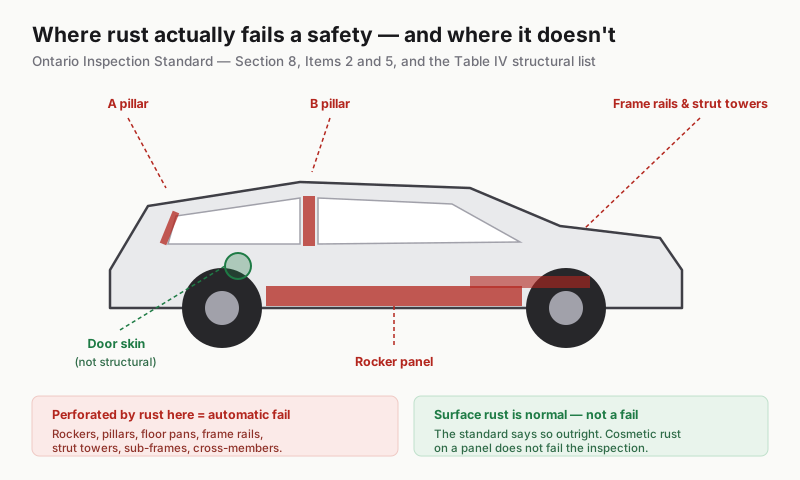
The standard states plainly that some rust and corrosion on the outer surface of exposed metal parts is normal, and that minor surface rust and corrosion is not cause for rejection. That is written into the document technicians work from.
What fails is corrosion that has gone further than the surface:
- A structural component perforated by corrosion — rusted through
- A component rusted or corroded to a depth sufficient to become weakened
- Frame members perforated or separated due to corrosion between the mount and the frame member
- A hole in the floor or a panel that lets water splash or exhaust enter the occupant compartment
So a bubbling fender is cosmetic. A rocker panel you can push a screwdriver through is not.
Which parts count as structural
This is the part worth knowing, because it tells you where to look. The standard includes a list of structural components drawn from Regulation 376/02. Corrosion perforation on any of these fails the vehicle:
- Radiator support assembly
- Upper and lower rail assemblies, left and right
- Front strut tower and apron assemblies, left and right
- Cowl top panel assembly
- Engine sub-frame assembly
- Dash panel assembly
- Windshield "A" pillar assemblies, left and right
- Side rocker panel assemblies, left and right
- Centre-hinge "B" pillar assemblies, left and right
- Rear "C" pillar assemblies, left and right
- Front and rear floor pan assemblies
- Structural roof panel assembly
- Rear strut tower and inner wheelhouse assemblies
- Inner quarter panel assemblies
- Rear cross-member assembly
- Upper and lower rear end panel assemblies
- Rear sub-frame assemblies
- Trunk floor pan assembly
- On a body-on-frame vehicle: the complete frame assembly
Read that list again and notice something: almost every item on it sits low on the vehicle, where salt spray and slush collect.
Why Ottawa is especially hard on cars
Ottawa runs one of the longer, more heavily salted winters of any major Canadian city. Salt brine gets thrown up into exactly the cavities the list above describes — the insides of rocker panels, the bottoms of the pillars, the seams of floor pans, strut towers, frame rails.
Two things make this worse than it looks:
Rust works from the inside out. A rocker panel rusts from the moisture trapped inside the cavity, not from the paint outward. By the time you see bubbling paint on the outside, the metal behind it is often already gone. A car can look clean at three metres and fail on structure.
Drain holes clog. Rockers, doors and rear quarters have factory drain holes. Once those pack with road grime, the cavity holds water permanently, and the vehicle effectively spends every winter soaking in salt water.
This is why an identical car of the same age and mileage from Alberta or B.C. often sails through a safety while the Ottawa example fails. If you are registering an out-of-province vehicle, this usually works in your favour.
Can rust be repaired to pass?
Sometimes — and the standard is specific about the limits.
Repair of holes in the vehicle floor caused by corrosion perforation is permitted, provided:
- The hole does not extend into a structural area of the floor, such as seat belt anchors, seat supports or rocker panels
- The prepared edges of the hole do not exceed 200 mm in length
- The repair does not extend within 50 mm of the tunnel, rocker, seat support structure or firewall/bulkhead
And the standard names methods that are not acceptable: no pop rivets, no arc welding or flame repair on high-strength steel, and no TIG or MIG stitch welding.
In other words: a small, contained floor hole away from anything structural can be properly repaired. A rotted rocker panel or a perforated frame rail is a different job entirely — and on many older vehicles the honest answer is that the repair costs more than the car is worth.
What about a rusty exhaust?
Different rules, and less strict than people assume. Surface rust on an exhaust does not fail the vehicle. What fails is:
- A manifold that is broken, cracked, leaking, loose or missing
- A muffler that is cracked, perforated or leaking — or bypassed, disabled, removed, or patched in a way inconsistent with industry standard
- A resonator, catalytic converter, particulate trap or exhaust pipe that is cracked, perforated or leaking
- Any exhaust component positioned so it causes heat damage to wiring, fuel lines or brake lines
- Any arrangement that lets exhaust gases into the occupant compartment
Helpfully, the standard notes that minor leaking and the resulting soot tracks at exhaust joints are normal. So light staining at a joint is not automatically a failure.
What about rusty brake lines?
This one catches people, because the rule cuts both ways. The standard says surface rust and corrosion on metal brake lines and fittings is normal and is not cause for rejection.
But a brake line fails if heavy rust, corrosion or scaling reduces or increases the thickness of the material or compromises its structural integrity — and it fails at a level 1 leak, the mildest category in the standard, meaning a damp film that does not even form drops. Brake lines also fail outright if repaired by welding or soldering.
Given Ottawa's salt, corroded brake lines are a genuinely common failure on vehicles over about ten years old, and one worth taking seriously: a line that bursts under emergency braking is exactly the scenario the standard exists to prevent.
How to slow it down
If you are keeping a vehicle here long term:
- Wash the undercarriage through winter, not just the paint. Any touchless wash with an underbody spray is worth the few dollars, especially during thaws when salt is most active.
- Keep drain holes clear. A quick poke with a zip tie at the bottom of the doors and rockers each fall genuinely helps.
- Consider annual oil-based rustproofing. It creeps into seams and cavities where hard undercoating cannot reach. Our rust proofing and undercoating guide covers the options.
- Deal with stone chips. A chip on a lower door or rocker is where the next perforation begins.
Frequently asked questions
Will surface rust fail my safety inspection? No. The standard describes surface rust and corrosion on exposed metal as normal and explicitly not cause for rejection. Cosmetic rust on a door skin, fender or quarter panel does not fail a vehicle.
Can I just patch a rusty rocker panel with fibreglass or filler to pass? No. Rocker panels are on the structural list, and the standard's repair allowances for floor perforation specifically exclude structural areas including rocker panels. A cosmetic patch over structural rot is not a repair — and a shop that certified it would be putting its licence at risk.
My frame has flaky rust. Is that a fail? Not by itself. Some rust and corrosion on the outer surface of exposed frame metal is normal. It fails when the frame is perforated, or rusted to a depth sufficient to become weakened — which a technician determines by cleaning back the scale and checking what solid material remains.
Is it worth fixing structural rust on an older car? Often not, honestly. Proper structural repair means cutting out the rotted section and welding in new metal to a standard the inspection will accept — real labour. On a vehicle worth two or three thousand dollars, the repair frequently exceeds the value. We will tell you that plainly rather than quoting a repair that does not make financial sense.
Not sure where your vehicle stands? Book a Safety Standards Certificate inspection at Franco Garage, or call (613) 789-2128. We are a licensed Vehicle Inspection Centre at 70 Beech Street, and we have been looking at what Ottawa winters do to cars since 1981.