
Brakes are the most heavily measured system in Ontario's vehicle inspection standard, and the most common reason vehicles fail. They are also the area where "it looked fine through the wheel" causes the most disappointment — because the standard does not accept a visual estimate. It requires numbers.
The wheels have to come off. That is not optional.
Before any of the numbers matter, understand this: the standard states that internal brake components must be inspected at every inspection, and that disassembly or removal of wheels and brake parts is required to make that inspection possible.
This is not a shop finding extra work. It is the written procedure. If someone offers you a safety inspection that takes fifteen minutes and never removes a wheel, you are not getting the inspection the province describes — and the certificate that results from it is worth exactly nothing to you if it is ever questioned.
The friction material limits
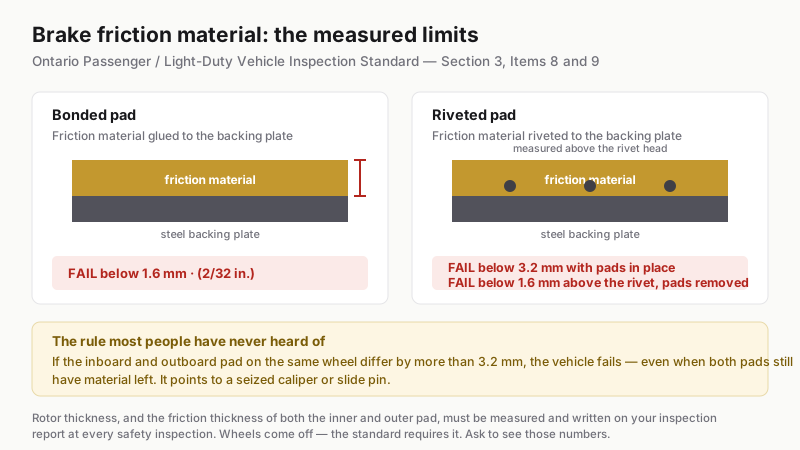
Bonded friction material — glued to the backing plate, which is what most modern pads use — fails below 1.6 mm. That is about 2/32 of an inch.
Riveted friction material has two limits depending on how it is measured:
- Below 3.2 mm with the pads still in place
- Below 1.6 mm above the rivet head with the pads removed
Drum brakes follow the same 1.6 mm floor: bonded shoe lining fails below 1.6 mm at its thinnest, and riveted lining fails below 1.6 mm above the rivet.
These are the fallback limits. Where the vehicle manufacturer specifies something stricter, the manufacturer's figure applies instead.
The rule almost nobody knows
Here is the one that surprises even experienced drivers.
If the inboard and outboard pad on the same wheel differ in friction thickness by more than 3.2 mm, the vehicle fails — regardless of whether both pads are still above the minimum.
Think about what that gap means. Both pads should wear at roughly the same rate. When one is dramatically thinner than the other, the caliper is not releasing evenly: a piston is sticking, or a slide pin has seized. The standard treats that as a defect in itself, because a seized caliper overheats the rotor, drags fuel economy, and eventually fails in a way you feel through the steering wheel.
So a vehicle can arrive with 5 mm on the outer pad and 1.5 mm on the inner and fail — not for the 5 mm pad, but for the mismatch that reveals a mechanical problem.
Rotor limits
A brake rotor fails when:
- Thickness at any point on the pad contact surface is less than the minimum marked on the rotor (or the manufacturer's or industry standard where nothing is marked)
- It is broken, pitted, or has surface cracks extending to the outer edge
- A crack runs from the friction surface through to a cooling vent
- The pad's contact pattern on solid, non-rusted rotor material is less than 75% of the radial width around the entire rotor on one side
- Lateral run-out or parallelism exceeds the OEM or industry standard
That 75% contact pattern rule is worth understanding: it catches rotors where a band of rust has built up because the pad was no longer sweeping the full face — common on a vehicle that sat, or where a caliper has been dragging.
Usefully, the standard notes that heat checks and some fine surface cracks on the friction surface are normal. A rotor with light hairline checking is not automatically failed.
The brake pedal tests
Two distinct tests, both revealing.
The 10-second test. With moderate foot force held on the brake pedal for 10 seconds (engine running on a power-boosted system), the pedal must not sink toward the fully applied position. If it creeps down, the master cylinder is bypassing internally and the vehicle fails.
The travel test. With heavy foot force applied, the vehicle fails if total pedal travel exceeds 80 per cent of the total available travel and, on a dual-circuit system, the brake failure warning lamp illuminates.
The master cylinder also fails for contaminated fluid, a fluid level below the indicated minimum (or more than 13 mm from the top where no minimum is marked), a damaged, loose or missing filler cap, plugged vent holes, or a missing or swollen gasket.
Brake lines: the strictest leak rule in the standard
Ontario grades fluid leaks into three levels — level 1 is a damp film that does not form drops, level 2 forms drops that do not fall, level 3 drips while you watch.
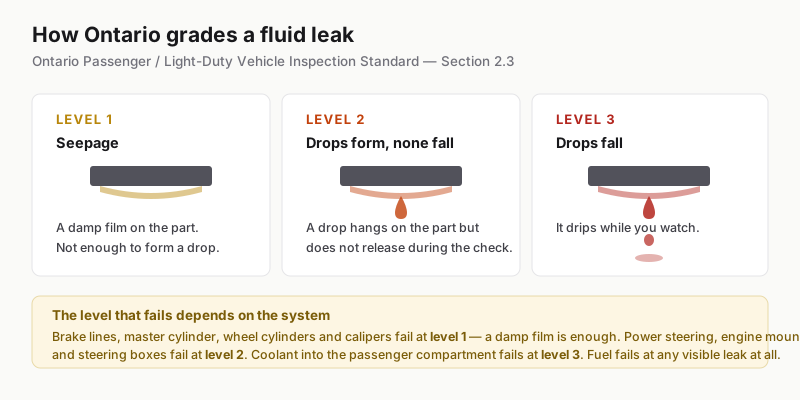
Brake components fail at level 1. A damp film on a brake line, a wheel cylinder, a caliper, the master cylinder or the differential pressure switch is enough to fail the vehicle. That is the strictest threshold in the entire standard, and it is strict for an obvious reason.
Metal brake lines are also inspected while the brakes are applied with heavy force, simulating an emergency stop. They fail for:
- Heavy rust, corrosion or scaling that changes the material thickness or compromises structural integrity — though surface rust is explicitly normal
- Chafing, cracks, flattening or a restricting section
- Insecure mounting that lets the line shift out of position
- Any repair by welding or soldering
- Connections that are not flared-type fittings, or do not meet OEM standard
Flexible hoses fail for bulging or swelling under pressure, twisting, flattening, or an outer cover cracked or chafed enough to expose an inner layer.
In Ottawa, corroded brake lines are a genuinely common failure on vehicles over about ten years old. Road salt gets everywhere, and brake lines run the length of the car.
The parking brake
Tested by fully applying it and attempting to move the vehicle in low forward and reverse gear at idle. If the vehicle moves with little or no resistance, it fails.
Where that test is not practical, the vehicle is raised with the parking brake engaged and the transmission out of park, and each braked wheel is checked by hand for resistance. The indicator lamp must light when the control is applied, and the brake must fully release when the release control is operated.
Will an ABS light fail my safety?
Usually not — and this genuinely surprises people.
For a passenger vehicle with a gross vehicle weight rating of 4,536 kg or less (essentially every car, SUV and light truck), a functioning ABS system is not required, and an illuminated ABS tell-tale is not by itself cause to fail. It must be recorded on the inspection report, but it does not fail the vehicle.
The exception matters though: if the ABS fault is actually affecting normal service brake operation — including how braking is proportioned between the front and rear axles — that fails.
Vehicles manufactured on or after April 1, 2000 with a GVWR above 4,536 kg are required to have working ABS, and a fault there does fail.
What this means practically
If your brakes are anywhere near the limits, get them measured before you book an inspection. The numbers are objective: a technician can tell you in a few minutes whether you have 4 mm or 1.8 mm, and whether the inner and outer pads are wearing evenly.
Catching a seizing caliper early also saves money. A sticking caliper destroys a rotor and its pad far faster than normal wear, so the difference between catching it and not is often the difference between a pad-and-rotor job and a pad, rotor and caliper job.
Frequently asked questions
How thin can brake pads be to pass an Ontario safety? 1.6 mm for bonded friction material. For riveted material, 3.2 mm measured with the pads in place or 1.6 mm above the rivet head with them removed. A manufacturer's stricter specification overrides these.
Do brake pads have to be replaced in pairs to pass? The standard does not require replacing in axle pairs as such, but it does fail a difference greater than 3.2 mm between the inner and outer pad on the same wheel. In practice, good repair procedure replaces pads across an axle so braking stays balanced.
Can I pass with a small brake fluid leak? No. Brake components fail at a level 1 leak — seepage not even great enough to form drops. This is the strictest leak threshold in the standard.
My brake light comes on sometimes. Will that fail? A brake system indicator lamp that indicates a malfunction or defect fails the vehicle. Intermittent illumination usually means low fluid (which itself can fail) or a fault in the system. Have it diagnosed before your inspection — see our dashboard warning lights guide.
Are rusty rotors an automatic fail? No. Rotors that have surface rust from sitting will clean up with use. What fails is thickness below the marked minimum, cracks to the outer edge or through to a cooling vent, or a pad contact pattern covering less than 75% of the rotor's radial width — which is where long-term rust build-up becomes a real problem.
Want the actual numbers on your vehicle? Book a Safety Standards Certificate inspection at Franco Garage and we will hand you the measurements in writing. Call (613) 789-2128 or visit us at 70 Beech Street in Ottawa. More answers in our complete Ontario safety inspection Q&A.