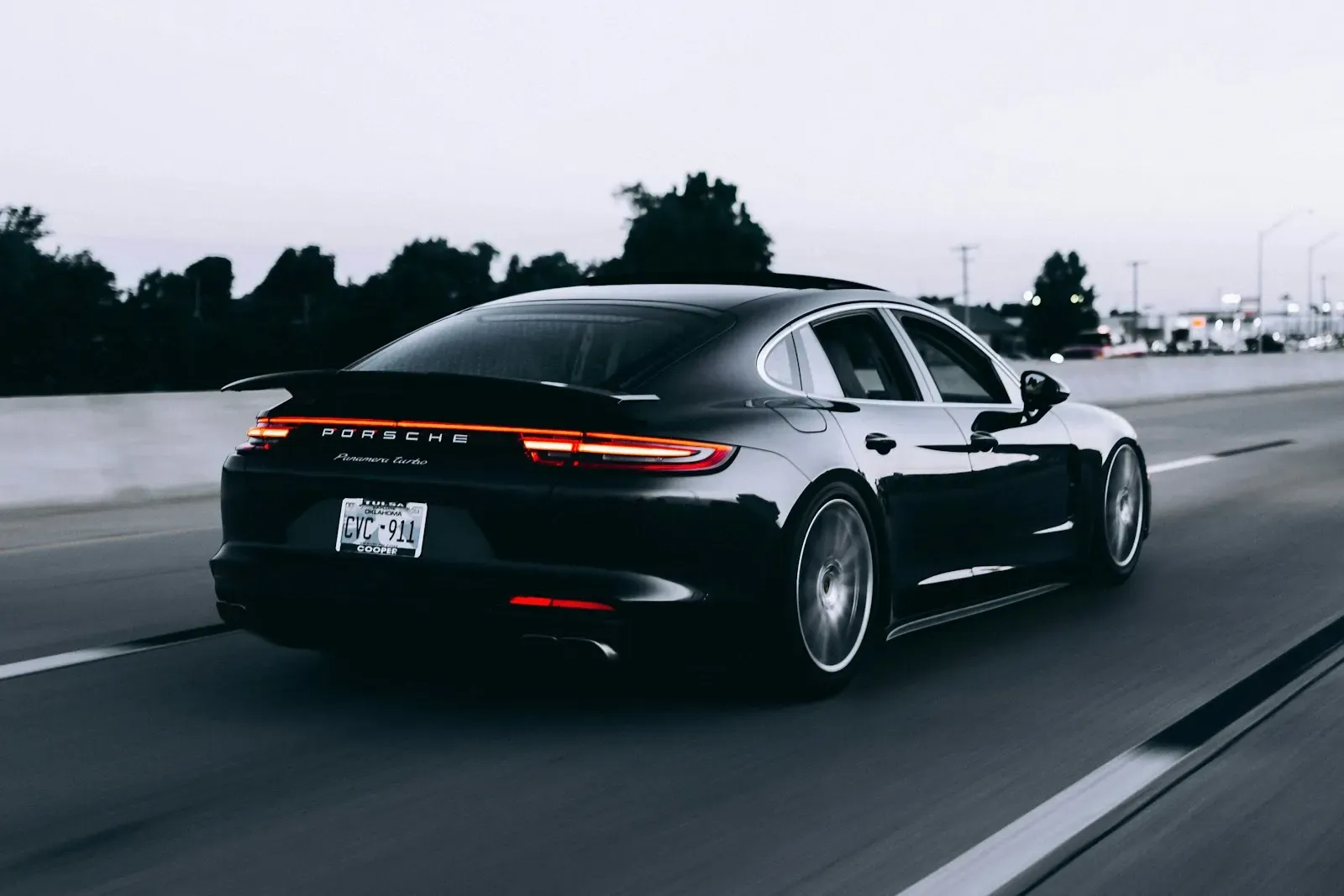
Most people picture a safety inspection as a car on a hoist. That is most of it — but Section 11 of Ontario's inspection standard is a required on-road evaluation, and it exists because some faults simply cannot be found with the vehicle sitting still.
If your vehicle went out on the road during its inspection, that was not a joyride. It is a defined procedure with minimum required elements.
What the road test must include
The standard sets out the minimum elements of a comprehensive road test:
- Driven at a speed in excess of 40 km/h
- A complete left and right turn at full lock — maximum steering wheel travel, against the stop
- From a minimum speed of 40 km/h, at least one heavy application of the service brakes, decelerating the vehicle to a complete stop
- Application and assessment of parking brake performance
- Driven over at least one bump equivalent to approximately 5 cm in height
And throughout: record all tell-tales, including those that do not result in failure of the vehicle.
The ground rules
The standard is explicit about the conditions:
- Valid licence plates must be displayed on the vehicle before it is road tested on a public road
- The person conducting the test must hold a valid driver's licence
- The Highway Traffic Act must be followed at all times
- The operator must use utmost caution to ensure the safety of other motorists
This is why an unplated vehicle matters when you book. If you have just bought a car, or brought one in from another province, and it has no valid plates, the road test cannot legally happen on a public road. A temporary trip permit from ServiceOntario solves it — mention the situation when you book so we can plan around it.
What the road test is looking for
Brakes
From at least 40 km/h, the brakes are applied hard enough to simulate an emergency stop. The vehicle fails if:
- Stopping distance is excessive, or the deceleration rate is inadequate
- Brakes pull to the left or right
- There is a tendency for premature lock-up of a wheel
- There is severe pulsation
- The ABS response is adversely affecting brake performance or vehicle control
That last one is worth noting alongside the general ABS rule. An ABS warning light on a normal passenger car does not by itself fail the vehicle — but if the system is actually interfering with braking during the road test, that fails regardless of what the dashboard says.
Pulling to one side usually means a seizing caliper or a collapsed flexible hose acting as a one-way valve. Severe pulsation usually means rotor thickness variation. Both are things you feel long before an inspection, and both are worth mentioning when you book.
Steering
The vehicle is driven over a bump and through turns. It fails if:
- Steering pulls left or right while driven in a straight line
- Steering reacts excessively to a bump
- The steering wheel does not automatically return most of the way to centre while exiting a turn
The return-to-centre test is a good example of what a static inspection misses. A binding strut bearing or a seizing upper mount can look perfectly fine on a hoist and be obvious the moment you exit a corner.
Shocks and struts
Observed while driving over bumps and uneven pavement, and during hard stops and sharp turns. The vehicle fails if it:
- Bounces excessively
- Pitches or dives excessively under hard braking
- Drifts on bumpy patches of road
Tire clearance
The vehicle is driven so as to cause suspension travel — bumps, uneven pavement. It fails if contact occurs between a tire and any other part of the vehicle.
This is the on-road half of a rule that has a static half too: at rest, clearance must be at least 25 mm at any point in a turn. The road test confirms what happens when the suspension actually compresses. It is the rule that catches oversized tires and lowered vehicles.
Drivetrain
- Differential: driven at low speed through a sharp turn, the vehicle fails if differential action is limited or non-existent, indicated by a drive tire skidding through the turn
- Transfer case: fails on evidence it is not functioning properly — wheel lock-up or shuddering while driving in a straight line
- Clutch: fails if it does not operate in the manner prescribed by the manufacturer
- Transmission: fails if the gear-shift indicator is inaccurate or not functioning, or if the shift lever binds or has excessive play
- CV and U-joints: fail if a joint is noisy — clicking, typically — during the road test and steering movement is adversely affected
Instruments
The odometer and speedometer are tested in operation. The vehicle fails if there is no odometer or it does not work, or if the speedometer is inoperative or missing.
Warning lights
Every tell-tale is cycled and recorded. The standard calls for starting the vehicle and checking the cycling of all tell-tales, turning the ignition on and off several times if needed to see them all.
The failures here are the same as elsewhere: an SRS (airbag) tell-tale displaying a malfunction fails, and an ESC tell-tale fails on vehicles where stability control is required — those manufactured on or after September 1, 2011, or September 1, 2012 for multistage manufactured vehicles.
The standard adds a practical note: some tell-tales stay on after a repair or system malfunction until vehicle speed reaches 8 to 16 km/h. So a light that extinguishes early in the road test is normal system behaviour.
Why this matters when choosing a shop
The road test is a good proxy for whether an inspection is being done properly. It takes time — you cannot do a required road test above 40 km/h with a full-lock turn in both directions and a hard stop from a parking lot in ninety seconds.
Combined with the requirement that wheels come off for the brake inspection, it is why a genuine Ontario safety inspection takes about an hour. A quoted price and turnaround that could not possibly cover both is telling you something.
Frequently asked questions
Is a road test required for an Ontario safety inspection? Yes. Section 11 of the Passenger/Light-Duty Vehicle Inspection Standard is a required on-road evaluation with defined minimum elements.
How fast do they drive my car during the inspection? Above 40 km/h at minimum, including at least one heavy brake application from a minimum of 40 km/h to a complete stop. The Highway Traffic Act must be followed throughout, and the technician is required to use utmost caution.
Can they road test my car if it has no plates? Not on a public road. Valid plates must be displayed. A temporary trip permit from ServiceOntario is the usual solution for an unplated vehicle — arrange it before your appointment.
Will the road test put extra kilometres on my car? A few. It is a short defined route covering the required elements, not an extended drive.
Can a car pass everything on the hoist and still fail the road test? Yes, and it happens. Return-to-centre steering problems, brake pull, excessive pitching under braking, a differential that will not differentiate, and tire contact under suspension compression are all faults that a static inspection can miss entirely.
Book a proper inspection. Wheels off, measurements recorded, road test included — Safety Standards Certificate inspection at Franco Garage. Call (613) 789-2128. 70 Beech Street, Ottawa.