
It depends on where the damage is — and that single fact resolves most of the confusion people have about windshields and safety inspections.
Two identical stone chips, one in front of the driver and one low on the passenger side, get completely different outcomes. Here is the rule.
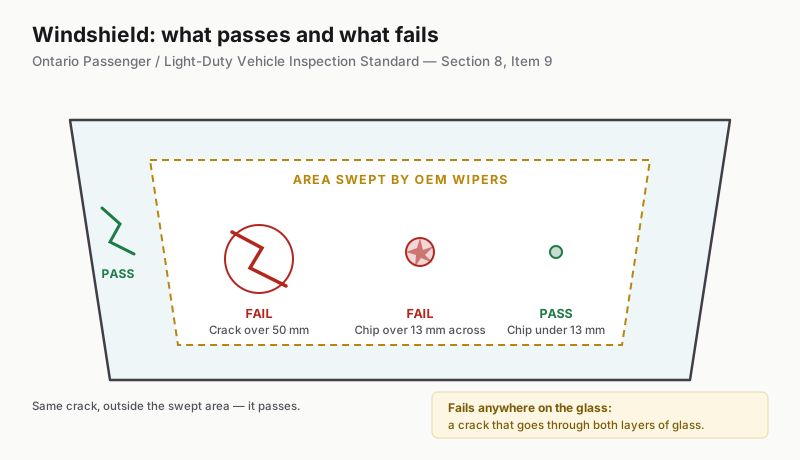
The swept area is what matters
Ontario's inspection standard measures windshield damage against the area swept by the OEM windshield wipers — the region your factory wipers actually clear.
Inside that swept area:
- A crack of any length that extends more than 50 mm fails
- A chip larger than 13 mm in diameter fails
Outside that swept area:
- The same crack passes
- The same chip passes
Anywhere on the glass:
- A crack that extends through both layers of glass fails
A windshield is laminated — two layers of glass bonded to a plastic interlayer. Damage through only the outer layer is common and often repairable. Damage through both layers has compromised the structural integrity of the glass, and the standard fails it regardless of position or size.
Other windshield failures
Beyond cracks and chips, a windshield fails if:
- More than 10% of the total glass area is discoloured due to age or deterioration
- Vision is obscured or limited due to surface condition
- The glass is crazed, clouded or fogged enough to materially impair vision
- It has exposed sharp edges
- It is not marked as type AS-1 or AS-10
- A decal or device obscures vision in the wiper-swept area
That last one has a specific exception: a forward-facing camera safety device may be mounted within the wiper-swept portion, provided it sits no more than 50 mm from the outer edge of that swept area. Dashcams and lane-keeping cameras are accommodated — a parking pass hanging in the middle of your view is not.
Window tint rules
This is where a lot of vehicles get caught, particularly ones with aftermarket tint applied by a previous owner.
For any vehicle manufactured on or after January 1, 2017:
- Any aftermarket tint applied to the windshield fails
- Light transmittance below 70% fails on the windshield
- Light transmittance below 70% fails on any window directly to the left or right of the driver
Tint that extends more than 75 mm down from the top of the windshield, or beyond the AS line, fails regardless.
Factory tint is fine. OEM tinting is designed not to block more than 30% of light — the same 70% transmittance threshold — so a vehicle with only its original glass passes.
Tint behind the driver's seat back is not restricted by these rules. So a limo-tinted rear window on a sedan is not a safety inspection problem; the front side windows are.
Side and rear windows
Side windows fail if:
- They fail to open or close as intended (vent windows that open less than 100 mm are excluded from this test)
- Normal vision is restricted on the windows immediately left and right of the driver
- Any window directly beside the driver is crazed, clouded or fogged enough to materially impair vision
- There are exposed sharp edges, or the glass is broken or partly missing
- Banding, if originally fitted, is missing, damaged or has exposed sharp edges
- Glass is not marked as an approved type (AS-1, AS-2, AS-3, AS-10 or AS-11 — with AS-3 permitted only behind the driver's seat back)
The rear window fails if broken or if it has an exposed sharp edge, and must be a marked, approved glass or rigid plastic type.
Mirrors
Every vehicle requires:
- An external rear view mirror on the left side
- An interior, centrally mounted rear view mirror providing an unobstructed view through the rear window
If the interior mirror does not give an unobstructed view — a cargo van, a vehicle loaded to the roof — then an external mirror on the right side is also required.
Mirrors fail for:
- A required mirror missing
- An obstructed view to the rear on a required mirror
- A mount that is broken, insecure, loose, or fails to hold the mirror in position
- A reflective surface that is cracked or broken
- Significant loss of reflecting area through deteriorated silvering, pitting, or contamination such as overspray
- A non-OEM or additional external mirror with less than 125 cm² of surface area on a vehicle with a GVWR of 4,536 kg or less
The sun visor
Small item, real failure: the driver's side sun visor must be present. It also fails if its attaching parts are bent, broken, loose or missing, or if it cannot be maintained in a set position.
Should I repair or replace?
If the damage is a chip smaller than 13 mm or a crack shorter than 50 mm inside the swept area, you are currently passing — but stone chips spread, and Ottawa's freeze-thaw cycle is exactly what makes them spread. Water works into the chip, freezes overnight, and expands.
A resin repair on a fresh, small chip is inexpensive and stops the propagation. Waiting until it runs into a 200 mm crack turns a repair into a full windshield replacement.
If your vehicle has a forward-facing camera behind the windshield — lane keeping, adaptive cruise, automatic emergency braking — a replacement usually requires recalibrating that camera afterward. Factor that in when you get quotes; a replacement that skips calibration can leave a driver assistance system quietly mis-aimed.
Frequently asked questions
How big can a windshield crack be and still pass in Ontario? Inside the wiper-swept area, a crack must not extend more than 50 mm. Outside the swept area there is no length limit — but a crack through both layers of glass fails anywhere.
Will a small stone chip fail my safety inspection? Only if it is larger than 13 mm in diameter and sits within the wiper-swept area. A smaller chip, or a larger one outside the swept area, passes.
Does aftermarket tint fail an Ontario safety inspection? On a vehicle manufactured on or after January 1, 2017, any aftermarket tint on the windshield fails, and less than 70% light transmittance fails on the windshield or on either front side window. Tint behind the driver's seat back is not restricted.
Can I use a dashcam mounted on my windshield? Yes. Forward-facing camera safety devices may be mounted within the wiper-swept area provided they sit no more than 50 mm from the outer edge of that area. A device mounted in the middle of the driver's view that obscures vision fails.
Is a missing interior mirror a fail? Yes, unless the vehicle has external mirrors on both sides. The requirement is a left external mirror plus an interior centre mirror with an unobstructed rear view — and when that rear view is not available, a right external mirror is required as well.
Not sure whether your windshield will pass? Bring it by and we will measure it against the standard. Book a Safety Standards Certificate inspection or call (613) 789-2128. Franco Garage is a licensed Vehicle Inspection Centre at 70 Beech Street, Ottawa.