Goodyear Assurance WeatherReady 2 Tires in Ottawa
The WeatherReady 2 is an all-weather tire: severe-snow rated, but built to stay on the car in July. It is the honest answer for the Ottawa driver who has nowhere to store a second set and no interest in booking a changeover twice a year.
Is there a rebate on this tire right now?
We run the manufacturer programs on these tires as they open, and they change through the season. Current amounts and dates are always on our specials page.
At a glance
| Category | All-weather touring |
|---|---|
| Severe snow rated | Yes — three-peak mountain snowflake |
| Designed for | Year-round use, no seasonal changeover |
| Compound | Soybean-oil infused, stays flexible below freezing |
| Water evacuation | Aqua-Tred grooves |
| Wear technology | Evolving Traction grooves |
| Noise | SoundComfort Technology |
| Treadwear warranty | 96,000 km |
| Fits | Sedans, coupes and crossovers |
All-weather is not all-season
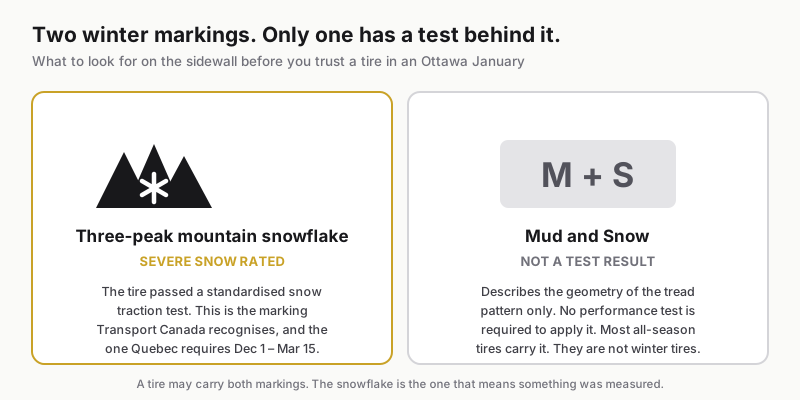
These two names sound interchangeable and are not. An all-season tire carries an M+S marking, which describes a tread pattern and has no test behind it; below about 7 °C its compound stiffens and it stops being good at winter. An all-weather tire carries the three-peak mountain snowflake, which means it passed a standardised snow traction test — the same marking a dedicated winter tire carries.
The WeatherReady 2 is in the second group. Goodyear designed it to hold that severe-snow rating while still being a tire you can sensibly drive through an Ottawa August, which is a genuinely hard engineering compromise: winter grip wants soft rubber, summer wear and handling want firm rubber.
What you give up is honest and worth stating plainly. On deep snow and glare ice, a dedicated winter tire is better. On a hot highway, a dedicated summer or all-season tire is better. The WeatherReady 2 is very good at neither extreme and good at everything in between — which for a lot of Ottawa drivers is exactly the right trade.
The technology, in plain terms
Goodyear’s published features for this tire, and what each is doing.
Soybean-oil infused compound
The compound uses soybean oil to stay flexible in subfreezing temperatures. This is the core of the all-weather trick: keeping the rubber pliable when it is cold without making it so soft that it wears away in the summer. It is why the tire can carry a snowflake and still hold a 96,000 km treadwear warranty.
Weather Reactive Technology with Aqua-Tred grooves
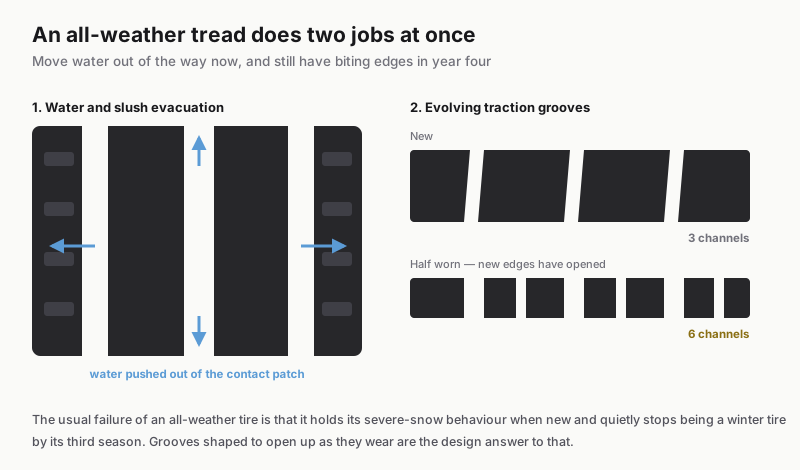
Wide channels sized to move standing water and slush out from under the contact patch. On the 417 in a March downpour, hydroplaning resistance is a function of how fast the tire can get water out of the way, and that is a geometry problem more than a compound one.
Evolving Traction grooves
The groove shapes change as the tread wears, so new biting edges appear over the tire’s life instead of disappearing. This addresses the usual failure of an all-weather tire: it holds its snowflake behaviour when new and quietly stops being a winter tire by its third season. Evolving grooves are Goodyear’s answer to that.
SoundComfort Technology and comfort inserts
A noise-damping layer plus inserts that absorb bumps and vibration while keeping steering response. A year-round tire spends more time on dry pavement than a winter tire does, so ride and noise carry more weight in the design than they would on a dedicated snow tire.
Is this the right tire for you?
The WeatherReady 2 suits you if
- You have nowhere to store a second set of tires — a Centretown apartment, a Glebe row house, street parking.
- You would rather not book and pay for a changeover twice a year.
- You drive mostly plowed, salted city and highway roads rather than unmaintained rural ice.
- Your annual mileage is moderate and you want the 96,000 km warranty to actually mean something.
Look at something else if
- You commute on unplowed rural roads or up a steep unmaintained driveway.
- You drive a lot of winter highway kilometres and want the shortest possible ice stopping distance.
- Your car is a heavy performance sedan or SUV — check the size range and load rating first.
- You already own winter rims, in which case the economics of a dedicated winter set are much better than they look.
Sizes, fitment and how we quote
We do not warehouse tires. We order in from our Ottawa distributors — usually the same or the next business day — and you get a full installed quote before we order anything. That quote includes mounting, balancing, valve stems or TPMS service kits, and old-tire disposal, so the number you see is the number you pay.
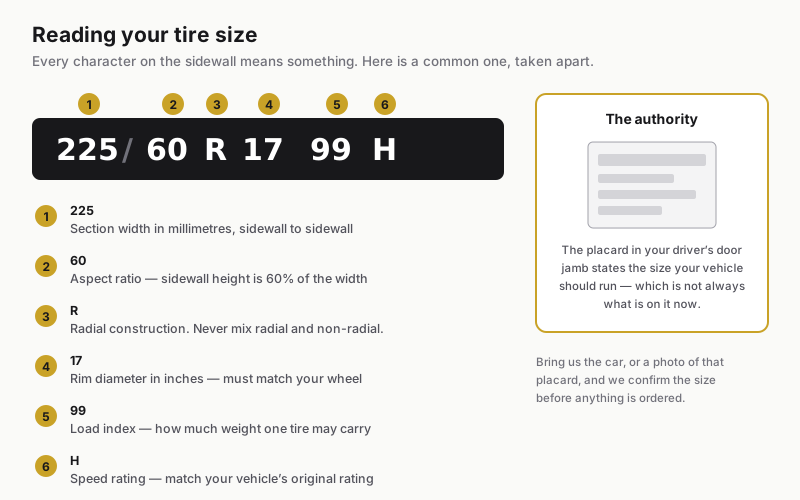
Bring the vehicle, or read the size off the placard in the driver’s door jamb, and we will confirm it against what your vehicle should be running. If your size is not made in this line we will tell you that rather than substituting something else quietly. More on what we do with the tires once they arrive is on our tire services page.
What this means for an Ottawa driver
The single-set argument is strongest in the dense parts of the city. If you live in Centretown, the Glebe, Hintonburg or Old Ottawa East, you probably have no garage, no basement space you want four tires in, and street parking. Storage is a real cost, either in money paid to a shop or in floor space you do not have. Add two changeover appointments a year, each booked in the busiest possible week, and the all-weather case makes itself.
The counter-argument is also real, and we will make it to you if it applies. Ottawa gets roughly eighty freeze-thaw cycles a year, and the resulting glaze on unplowed side streets is the surface where a dedicated winter tire is meaningfully better. If your street is plowed late, or your commute takes you onto rural roads west or south of the city, a winter set is the safer answer and we will say so.
- Because it is snowflake-rated, this tire satisfies Quebec’s December 1 to March 15 winter tire requirement — so it works if you commute to Gatineau.
- Ontario insurers have been required since 2016 to offer a winter tire discount, typically 2–5%. Snowflake-rated all-weather tires generally qualify, and because you run them year-round the discount applies without any seasonal paperwork. Confirm with your broker.
- A year-round tire needs rotation more than a seasonal set does, because it never gets the natural repositioning that a changeover provides. Every oil change is a reasonable rhythm.
- Ontario’s safety inspection fails a passenger tire below 2 mm. An all-weather tire stops behaving like a winter tire well above that — do not run it down to the legal limit and expect January performance.
What installation includes here
Mounting and balancing
Every tire is balanced on the machine, not eyeballed. An unbalanced wheel shows up as a vibration at a specific speed and chews the tire unevenly.
Valve stems or TPMS kits
Rubber valve stems get replaced with the tire. TPMS sensors get new service kits — the seals and collars are consumables, not permanent parts.
Torqued to specification
Wheels go on with a torque wrench to your vehicle’s spec, not an impact gun. Over-torquing warps rotors; under-torquing loses wheels.
Pressures set properly
Set to the placard, or to the load if you tow. Cold-weather pressure drops are why the light comes on the first cold morning.
Old tire disposal
Included in the quote. Ontario tire stewardship fees are part of the number we give you, not a surprise at the counter.
Seasonal storage
Ask us — if you have nowhere to keep a second set, we can talk about what storage looks like.
Related reading
X-Ice Snow
Look at this one if you decide a dedicated winter set is the safer call after all.
NexenNexen winter tires
Look at this one Nexen’s N’Blue 4Season 2 and Roadian HTX2 are all-weather alternatives at a lower price point.
- All tires we fit in Ottawa
- Balancing, repair, rotation, TPMS and seasonal changeover
- Current tire rebates and shop offers
- Ontario safety standards certificate
- Tire rules for an Ontario safety inspection
- Why rotation and balancing matter here
- Tire maintenance: safety and performance
Specifications and program details on this page reviewed with our distributors: September 2026.
Assurance WeatherReady 2 — questions we actually get asked
Straight answers, from the counter at Beech Street.
The sidewall marking. An all-season tire carries M+S, which describes tread geometry and involves no test. An all-weather tire carries the three-peak mountain snowflake, which means it passed a standardised snow traction test — the same rating a dedicated winter tire has to earn. The WeatherReady 2 is an all-weather tire. If a tire does not have the snowflake, it is not a winter-capable tire regardless of what it is called.
For most city and highway driving, yes — that is what the severe-snow rating means. The honest limits are deep unplowed snow and glare ice, where a dedicated winter tire is better. Our rule of thumb: if your street gets plowed and your commute is arterials and highway, an all-weather is a reasonable choice. If you regularly drive unmaintained rural roads or a steep driveway, buy winter tires.
Often, but less than people expect. You avoid two changeovers a year and any storage cost, and you do not buy a second set of rims. But you wear one set of tires 12 months a year instead of splitting the mileage across two sets, so you replace them sooner. The saving is real for lower-mileage drivers and for anyone paying for storage; it shrinks as your annual mileage climbs.
Goodyear publishes a 96,000 km treadwear warranty, which is high for a snowflake-rated tire and reflects the compound work. Bear in mind you are running these year-round, so that mileage accumulates faster than it would on a seasonal set. Rotation on schedule matters more here than on tires that get swapped twice a year.
No. Mixing tire types across axles gives you different grip levels front and rear, which is how a car ends up spinning under braking on a wet ramp. Ontario’s safety inspection standard also has rules about mismatched tires. Four the same, always.
We do not warehouse tires. We order in from our Ottawa distributors, usually the same or the next business day, and we quote the full installed price before ordering anything. Bring the car or read the size from the driver’s door jamb sticker and we will confirm it against the placard.
What Ottawa Customers Say About Our Service
"I dropped my car off at Franco Garage around 11:15am (no appointment, they took me right away) and by 12:30pm they had already ordered my car battery AND installed it! The cost was amazing. They only charged me for the battery itself (under $200) and $15 for labour. Everywhere else I called prior to Franco Garage was quoting between $250-$432 for the battery alone and a high labour cost, not to mention long wait times. I will definitely bring my car back to Franco Garage!! What an incredible experience. The service was extremely fast and the guys working were honest, reliable and really personable!"
Natasha Ferrill
3 months ago
"Noticed I had a deflating tire and a 6AM trip to Montreal the next day. The guys were already fully booked for the day, but still squeezed me in for a quick fix. I didnt even have to wait anywere, they were done in under 15 minites. Both mechanics were very polite and even offered to walk i to the ahop and showed me exactly what was causing the leak in the tire. They knew I was in a rush, but still charged me a fair price. I couldn't be happier, they actually made my day :)"
Yehor Sanko
3 months ago
"Fair and competitive rates. Friendly service and no BS! Thanks from the Dad trying to manage a brake job on his son’s car from Toronto!"
jdyyz
6 months ago
Want a price on a set?
Tell us the vehicle and we will quote the tires installed — all in, before we order anything. Family-run on Beech Street since 1981.