Michelin X-Ice Snow Tires in Ottawa
The X-Ice Snow is Michelin’s studless winter tire for cars and crossovers — the one you buy when you want a dedicated winter set and you want it to still be a good tire in its fourth season, not just its first.
Is there a rebate on this tire right now?
We run the manufacturer programs on these tires as they open, and they change through the season. Current amounts and dates are always on our specials page.
At a glance
| Category | Dedicated winter (studless) |
|---|---|
| Severe snow rated | Yes — three-peak mountain snowflake |
| Studdable | No |
| Tread compound | FLEX-ICE 2.0 |
| Sipe design | Two full-depth 3D types — notched and variable-thickness |
| Wear technology | Michelin EverGrip |
| Treadwear warranty | About 60,000 km on H- and T-rated sizes |
| Standard limited warranty | 6 years |
| Fits | Passenger cars, crossovers and small SUVs |
What the X-Ice Snow is
The X-Ice Snow replaced the X-Ice Xi3 as Michelin’s mainstream studless winter tire for passenger cars and crossovers. Studless means it gets its ice grip from the rubber compound and from thousands of cut edges in the tread, rather than from metal pins. For almost everyone driving in Ottawa, that is the right answer: our streets are plowed and salted, so a studded tire spends most of its life scrabbling on bare asphalt.
Michelin’s design argument for this tire is about the back half of its life. A winter tire is easy to make grippy when it is new and 11 mm deep. It is much harder to keep it grippy at 6 mm, in year four, which is where most of us actually are. Two of the three headline technologies on this tire — EverGrip and the full-depth sipes — exist for that reason rather than for the showroom.
The technology, in plain terms
These are Michelin’s published technologies for this tire. What follows each name is what it means on a February morning on the Queensway.
FLEX-ICE 2.0 compound
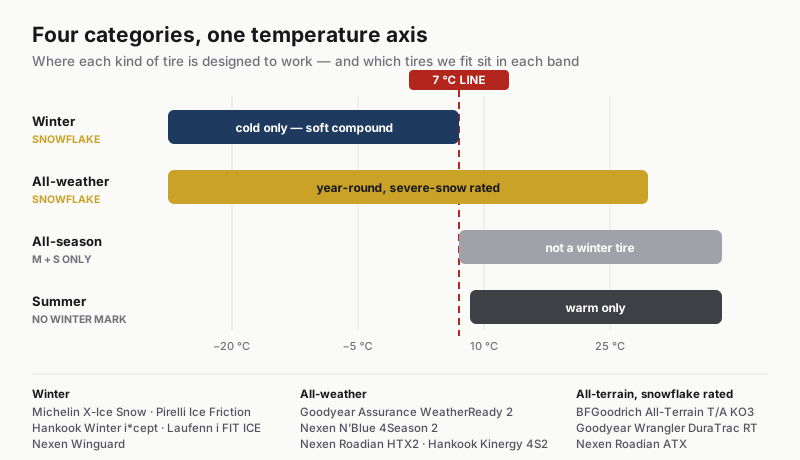
The rubber formulation. Winter compounds are built to stay pliable well below freezing, where an all-season compound stiffens and stops conforming to the road surface. A stiff tire skates over ice texture; a pliable one settles into it. This is the single biggest reason a winter tire outperforms an all-season below about 7 °C, and it is a property of the rubber, not the tread pattern.
Michelin EverGrip
The grooves are shaped so that they widen as the tread wears down. A new tire has deep, narrow channels; a worn one would normally have shallow, narrow channels and nowhere for slush to go. Widening them as they get shallower keeps the tire clearing water and slush later into its life, which is exactly when most people are still driving on it.
Two kinds of full-depth 3D sipe
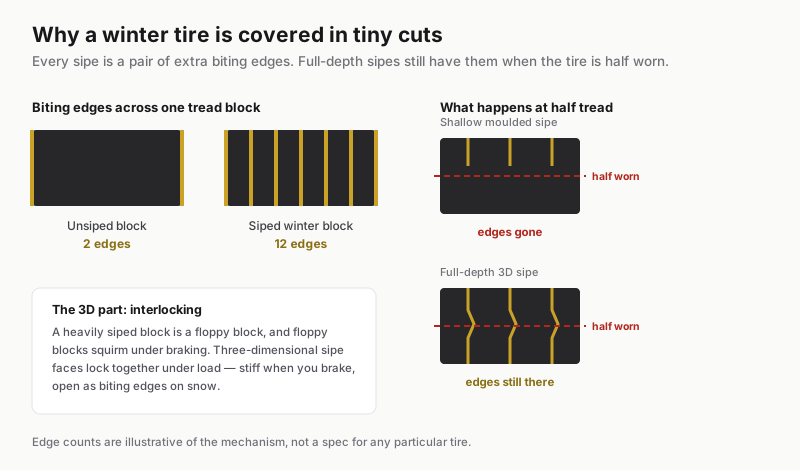
Sipes are the fine cuts across the tread blocks. Each one is a biting edge that grabs ice. Michelin uses two shapes here — notched and variable-thickness — and both run the full depth of the tread. Full-depth matters: a sipe moulded only into the top few millimetres disappears halfway through the tire’s life, taking its edges with it. These do not.
A three-peak mountain snowflake rating
The snowflake-in-a-mountain symbol on the sidewall means the tire passed a standardised snow-traction test. It is the marking Transport Canada recognises for severe snow service, and it is what Quebec requires between December 1 and March 15. An M+S marking on its own is a tread-pattern description with no test behind it.
Is this the right tire for you?
The X-Ice Snow suits you if
- You drive a car, crossover or small SUV and you want a dedicated winter set on its own rims.
- You keep tires for four or five seasons and want the last two to still be good.
- You commute on plowed, salted roads — the Queensway, Bank, Bronson, Carling — rather than unmaintained rural ice.
- You cross to Gatineau in winter and need a tire that satisfies Quebec’s December-to-March requirement.
Look at something else if
- You want one set of tires on the car all year — that is an all-weather tire, not this.
- You drive a three-quarter-ton truck or a large SUV; check the size range before you plan around it.
- You want the outright shortest stopping distance on glare ice and are willing to accept studs and the noise and dry-road compromises that come with them.
- Your vehicle stays parked all winter and comes out in April.
Sizes, fitment and how we quote
We do not warehouse tires. We order in from our Ottawa distributors — usually the same or the next business day — and you get a full installed quote before we order anything. That quote includes mounting, balancing, valve stems or TPMS service kits, and old-tire disposal, so the number you see is the number you pay.
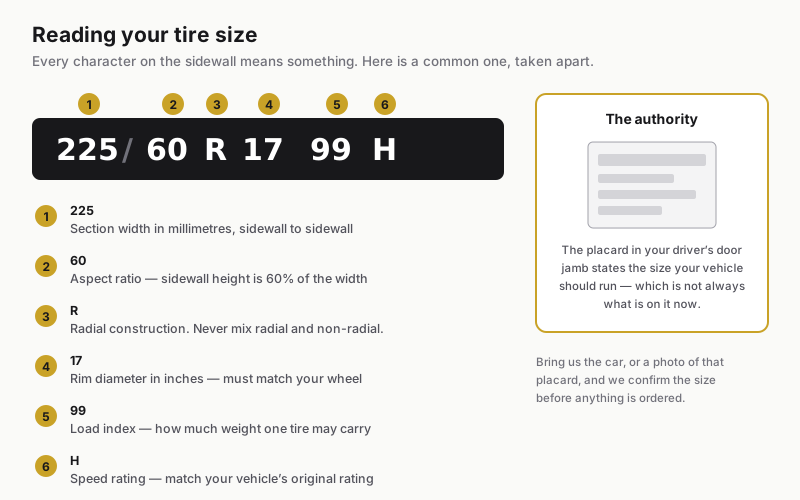
Bring the vehicle, or read the size off the placard in the driver’s door jamb, and we will confirm it against what your vehicle should be running. If your size is not made in this line we will tell you that rather than substituting something else quietly. More on what we do with the tires once they arrive is on our tire services page.
What this means for an Ottawa driver
Ottawa is a hard place on tires for a reason people often miss: it is not the cold, it is the cycling. The city sees roughly eighty freeze-thaw cycles in an average year across about 6,000 kilometres of road. Every one of those cycles turns yesterday’s melt into this morning’s glaze, usually on the side streets that get plowed last and salted least. That is the surface a studless winter tire is designed for, and it is the surface an all-season tire is worst on.
The other thing that pushes Ottawa drivers onto a dedicated winter set is the river. Quebec requires winter tires on every registered passenger vehicle from December 1 to March 15. If you cross to Gatineau for work, that requirement is a practical fact of your winter even though Ontario has no equivalent rule.
- Ontario does not require winter tires — but since 2016 every Ontario auto insurer has been required to offer a winter tire discount, typically in the 2–5% range. Ask your broker; it is not applied automatically.
- Quebec’s mandate runs December 1 to March 15 and applies to vehicles registered there, which matters if you have a second vehicle plated across the river.
- Ontario’s safety inspection fails a passenger tire below 2 mm of tread. That is a legal floor, not a winter recommendation — a winter tire is largely done as a winter tire well before it gets there.
- We are on Beech Street, off Preston in the Little Italy end of Centretown — a straightforward run from the Glebe, Hintonburg, Old Ottawa South and the Civic Hospital area.
What installation includes here
Mounting and balancing
Every tire is balanced on the machine, not eyeballed. An unbalanced wheel shows up as a vibration at a specific speed and chews the tire unevenly.
Valve stems or TPMS kits
Rubber valve stems get replaced with the tire. TPMS sensors get new service kits — the seals and collars are consumables, not permanent parts.
Torqued to specification
Wheels go on with a torque wrench to your vehicle’s spec, not an impact gun. Over-torquing warps rotors; under-torquing loses wheels.
Pressures set properly
Set to the placard, or to the load if you tow. Cold-weather pressure drops are why the light comes on the first cold morning.
Old tire disposal
Included in the quote. Ontario tire stewardship fees are part of the number we give you, not a surprise at the counter.
Seasonal storage
Ask us — if you have nowhere to keep a second set, we can talk about what storage looks like.
Related reading
Assurance WeatherReady 2
Look at this one if you would rather run one set of tires all year than swap twice a season.
PirelliIce Friction
Look at this one if your car came on 18- or 19-inch wheels, or it is an EV.
- All tires we fit in Ottawa
- Balancing, repair, rotation, TPMS and seasonal changeover
- Current tire rebates and shop offers
- Ontario safety standards certificate
- Tire rules for an Ontario safety inspection
- Why rotation and balancing matter here
- Tire maintenance: safety and performance
Specifications and program details on this page reviewed with our distributors: September 2026.
X-Ice Snow — questions we actually get asked
Straight answers, from the counter at Beech Street.
All-wheel drive helps you accelerate. It does nothing for you when you brake or turn, because those are jobs for the four contact patches, and all four are the same size whether the car is AWD or not. An AWD vehicle on all-seasons will pull away from a stop sign confidently and then need the same distance to stop as anything else. If you only change one thing about your winter setup, change the tires, not the drivetrain.
You can, but you should not. A winter compound is soft by design, and running it through an Ottawa summer wears it out fast and gives you vaguer steering and longer warm-weather braking than an all-season would. If a single set is what you want, look at an all-weather tire like the Goodyear Assurance WeatherReady 2 instead — that is what all-weather tires exist for.
Go by temperature, not by snowfall. Once daily highs are consistently at or below about 7 °C, an all-season compound is already stiffening and a winter compound is already the better tire. In Ottawa that is usually somewhere in the second half of October. Waiting for the first real snowfall means booking a changeover in the same week as everyone else in the city.
If you plan to keep the car more than two winters, yes. A second set of rims means the seasonal changeover is a wheel swap rather than a tire-off-rim job — quicker, cheaper each time, and easier on the tire beads and on your TPMS sensors. The rims pay for themselves over a few seasons on labour alone.
Michelin publishes a treadwear warranty of about 60,000 km on the H- and T-rated sizes, with a six-year standard limited warranty. Most Ottawa drivers running them only from late October to April will hit the age limit before the mileage one. Rubber ages whether you drive on it or not, so a set that is stored well but is ten years old is not a winter tire any more, however much tread is left.
We do not warehouse tires. We order in from our Ottawa distributors, usually the same or the next business day, and we quote you the full installed price before anything is ordered. Bring the car or read the size off the sticker in the driver’s door jamb and we will confirm it against the placard.
What Ottawa Customers Say About Our Service
"I dropped my car off at Franco Garage around 11:15am (no appointment, they took me right away) and by 12:30pm they had already ordered my car battery AND installed it! The cost was amazing. They only charged me for the battery itself (under $200) and $15 for labour. Everywhere else I called prior to Franco Garage was quoting between $250-$432 for the battery alone and a high labour cost, not to mention long wait times. I will definitely bring my car back to Franco Garage!! What an incredible experience. The service was extremely fast and the guys working were honest, reliable and really personable!"
Natasha Ferrill
3 months ago
"Noticed I had a deflating tire and a 6AM trip to Montreal the next day. The guys were already fully booked for the day, but still squeezed me in for a quick fix. I didnt even have to wait anywere, they were done in under 15 minites. Both mechanics were very polite and even offered to walk i to the ahop and showed me exactly what was causing the leak in the tire. They knew I was in a rush, but still charged me a fair price. I couldn't be happier, they actually made my day :)"
Yehor Sanko
3 months ago
"Fair and competitive rates. Friendly service and no BS! Thanks from the Dad trying to manage a brake job on his son’s car from Toronto!"
jdyyz
6 months ago
Want a price on a set?
Tell us the vehicle and we will quote the tires installed — all in, before we order anything. Family-run on Beech Street since 1981.